- Call us: + 61 3 9375 4286
- Email: mail@hoc.com.au

Dynamic PAYG Instalments: What Australian Small Businesses Need to Know Before 2027
Quick number to sit with for a second: the ATO currently charges 11.43% general interest charge, compounding daily, on underpaid tax for the July–September 2026 quarter. That’s a higher rate than most business overdrafts. And since 1 July 2025, you can’t even claim it as a deduction anymore. It’s just gone, straight off your bottom line.
Here’s another one. The ATO’s own figures put Australia’s small business income tax gap at $27.2 billion for 2022–23 , meaning roughly 17% of the tax small businesses should be paying isn’t landing where it should,often through nothing more sinister than messy records and inaccurate estimates, rather than deliberate dodging.
Put those two numbers together and you get a fairly blunt picture of why the current PAYG instalment system frustrates so many small business owners. Pay too much based on stale numbers, and you’ve unnecessarily restricted your own cash flow.
Guess wrong the other way, and you’re staring down an 11.43% compounding penalty that no longer even softens your tax bill.
That’s the exact gap the ATO is trying to close with dynamic PAYG installments Australia wide, from 1 July 2027. We’ve had a steady run of clients asking about this, so let’s pull it apart , what’s confirmed, what’s still just an announcement, and what to actually do about it at Hughes O’Dea Corredig.
The Quick Answer
If you’re short on time, here’s the gist.
- Dynamic PAYG instalments let approved accounting software calculate your instalment from real-time business data, instead of your last lodged tax return.
- Announced in the 2026–27 Federal Budget, targeting broader software adoption from 1 July 2027.
- A monthly PAYG instalment option was also floated for the same date, but according to the ATO’s own guidance, it’s not yet law.
- Opt-in only, currently running through an expanded ATO pilot across 2026–27.
- The GDP adjustment factor for 2026–27 sits at 5%, up from 4% the year before , so amount-method installments are already climbing regardless of dynamic PAYG.
- GIC is currently running at 11.43% and hasn’t been deductible since July 2025 , accurate variation matters more than it ever has.
The Problem This Is Actually Trying to Solve
The cost of getting a PAYG instalment wrong has been climbing all year , and it’s not a one-off spike.
Data
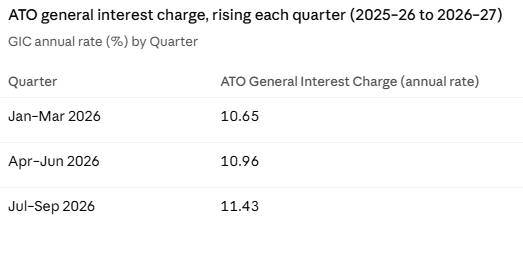

[Chart: ATO general interest charge, rising each quarter , 10.65% (Jan–Mar 2026) → 10.96% (Apr–Jun 2026) → 11.43% (Jul–Sep 2026). Source: ATO, General interest charge (GIC) rates, last updated 5 June 2026.]
Three quarters running, the rate’s gone up. GIC compounds daily on any underpaid instalment, and since 1 July 2025 it’s no longer tax deductible , so every one of those percentage points now lands straight on your bottom line with nothing to soften it.
This is precisely the pressure the ATO is trying to engineer out of the system with dynamic PAYG installments. Their Dynamic PAYG bulletin puts it plainly , the aim is to help businesses “align payments with their real-time performance,so fewer businesses end up on the wrong side of a rising GIC rate in the first place.
Add in the Xero-cited stat that one in four Australian SMEs already name late payments as a key survival risk, with average losses of $2,400 a month , call it $28,000 a year , from slow-paying clients, and you can see why a tax instalment system that ignores your actual cash position is such a sore point.
What Are Dynamic PAYG Instalments?
Let’s define it properly because there’s already a fair bit of confusion around it.
Dynamic PAYG instalments , sometimes shortened to dynamic PAYG , is a new ATO-approved calculation method built directly into accounting software you’re probably already using. Think Xero, MYOB, that kind of thing.
Instead of the ATO working out your instalment from your last tax return, the dynamic PAYG calculation pulls from your current business performance revenue, expenses and adjustments — as recorded in your books.
Here’s how the mechanics are meant to work:
- Your accounting software captures your current revenue and expenses as you go
- Approved software applies the ATO’s dynamic PAYG calculation method
- Your instalment is varied through the normal tax-administration process
- Your cash reserve tracks a figure that actually reflects your business today, not eighteen months ago.
The ATO ran an initial pilot in the 2024–25 financial year, and is expanding that pilot for 2026–27, working with software providers ahead of a broader rollout from July 2027. Their wording matters here , broader adoption is “subject to the results of the pilot and consultation,” not a locked-in guarantee for every product on day one.
Why This Actually Matters for Your Business
This isn’t just a compliance footnote. A few reasons it’s worth paying real attention to.
It’s a genuine attempt to fix a real cash flow problem. Under the current rate or amount method, a business that’s changed materially since its last tax return can be paying installments wildly out of step with reality , exactly like the chart above.
The ATO has published its compliance stance. Draft guideline PCG 2026/D3 confirms the ATO won’t chase GIC on businesses using the dynamic calculation method as intended. That’s a meaningful signal, not just marketing spin.
It doesn’t reduce your tax bill.Worth repeating: this is about timing, not a discount.
A quieter installment during a slow month doesn’t erase the liability if profits bounce back later in the year.
The GDP adjustment factor is already climbing. If you’re on the amount method, your instalment jumps 5% this year regardless of what dynamic PAYG eventually delivers , up from 4% in 2025–26.
GIC is no longer tax deductible, and it’s not cheap. At 11.43% compounding daily for the current quarter, an underestimated instalment adds up fast , and you can’t soften the blow with a deduction anymore.
Your books are the actual bottleneck. A faster, smarter calculation built on messy, inconsistent data just produces a wrong answer sooner. That’s the bit nobody’s software ad mentions.
What’s Confirmed vs What’s Still Just a Proposal
This is where a lot of online commentary gets sloppy, so let’s be precise.
Confirmed and moving:
- The ATO ran an initial pilot in 2024–25 and is expanding it through 2026–27
- Draft PCG 2026/D3 on GIC and excessive variation has been published for consultation
- The ATO is targeting broader software-provider adoption from 1 July 2027
- The 2026–27 GDP adjustment factor (5%) and current GIC rate (11.43%) are both locked in and already affecting instalments today
Announced, but not yet law:
- The optional monthly PAYG instalments Australia scheme, letting businesses opt to report and pay monthly instead of quarterly from 1 July 2027
- Mandatory monthly reporting for taxpayers with a “history of non-compliance”
The ATO’s own developer guidance is explicit , the voluntary monthly PAYG instalments 2027 option is announced, not legislated. Treat 1 July 2027 as a planning horizon, rather than a locked date, until final rules and eligibility criteria are published.
Are Dynamic PAYG Instalments Compulsory , and Who’s Affected?
Short answer: no, they’re opt-in. Nobody’s being forced onto the dynamic PAYG calculation the moment it launches.
Who’s likely to be affected once it rolls out wider:
- Sole traders and contractors already inside the PAYG instalment system (instalment income of $4,000+ and tax payable of $1,000+ on your last assessment)
- Companies and super funds, who automatically enter the system once instalment income hits $2 million or more
- Businesses using cloud accounting software with an ATO-approved integration once one’s live
- Seasonal businesses , hospitality, retail, trades , where income swings hard quarter to quarter, exactly like the Q3 dip in the chart above
If your income is dead stable year to year, the payoff here is smaller. If you’re the kind of business where March looks nothing like June, this is genuinely worth watching closely.
A Practical Checklist Before July 2027
You don’t need to guess the final rulebook to start preparing. Here’s what we’re telling clients right now.
✓ Reconcile monthly, even if you lodge quarterly. Pick a fixed day after the month-end, reconcile the bank and payment accounts, chase unpaid invoices, record payroll properly. A messy ledger makes any dynamic PAYG calculation software unreliable.
✓ Separate GST from income and expenses. Instalment income is reported excluding GST , mixing the two muddies every downstream number.
✓ Split personal and business transactions. Sounds obvious. Still the number one thing we find tangled up when we open a new client’s file.
✓ Build a rolling tax-reserve forecast. Year-to-date income, known seasonal patterns, PAYG installments already paid, a conservative reserve target. Update it monthly.
✓ Know the 85% rule cold. If you vary an instalment and it comes in under 85% of your actual tax payable for the year, the ATO can hit you with GIC on the shortfall , currently running at 11.43%, and not deductible.
✓ Keep evidence for every variation. Profit-and-loss snapshot, bank reconciliation, forecast assumptions, notes on anything unusual. If the ATO ever asks why you varied, you want a paper trail ready to go.
✓ Ask your software provider the hard questions. What data feeds the calculation? What gets excluded? Does a human review the proposed variation before it’s submitted?
✓ Loop in your accountant. Share the same reports and assumptions with whoever handles your BAS and PAYG installments; a shared source of truth avoids your books, your forecast, and your lodged activity statement telling three different stories.
Common Mistakes and Myths Doing the Rounds
“Monthly PAYG installments start automatically for everyone in July 2027.” Not true. It’s an opt-in proposal, still not legislated, and only certain non-compliant taxpayers face a mandatory monthly switch.
“Dynamic PAYG installments will lower my tax bill.” No , they change when you pay, not how much you ultimately owe.
“PAYG installments and PAYG withholding are the same thing.” They’re not. PAYG installments are prepayments on your own business and investment income. PAYG withholding is what you deduct from employee wages and remit on their behalf. Different divisions of the tax law, different ledger accounts.
“My revenue dashboard is basically a tax forecast.” Revenue can climb while profit falls thanks to contractor costs, freight, financing, or wages. A sales figure alone tells a dynamic PAYG calculation next to nothing useful.
“A healthy bank balance means I’m covering my tax obligations.” Not necessarily , that balance might include a loan drawdown or a customer deposit that isn’t actually yours to spend. Remember the ASBFEO-cited stat: SMEs lose an average of $2,400 a month to late-paying clients, and that cash sitting in debtors can look a lot like tax reserve when it isn’t.
When to Take Action
Move on this sooner rather than later if:
- Your income is genuinely seasonal and your current instalments feel out of step with reality , like the pattern in the chart above
- You’re using cloud accounting software (Xero, MYOB, QuickBooks) likely to get an ATO-approved dynamic PAYG feature
- You’ve been caught out by GIC on an inaccurate variation in the past, especially now it’s compounding at 11.43% with no deduction to soften it
- Your bookkeeping has gaps , messy bank feeds, late invoicing, personal and business transactions blurred together
- You’re weighing up whether monthly PAYG instalments would actually suit your cash flow once the rules are finalised
If any of that sounds familiar, now’s a sensible time for a proper conversation rather than waiting for the software to land on your desktop.
How HOC Helps Small Businesses Get PAYG-Ready
This is exactly the kind of change Hughes O’Dea Corredig exists for , technical, evolving, and genuinely consequential for a small business’s cash position.
Tax Planning & Tax Returns
Our tax planning and tax return service is where PAYG instalment strategy actually lives. We review your instalment method, model variations properly against the 85% threshold, and make sure your lodgements reflect your real trading position , not a stale figure from your last return.
Business Advisory
Through our business advisory practice, we help small business owners build the kind of rolling cash flow forecast that makes any future dynamic PAYG calculation software actually trustworthy , separating operating profit from bank cash so a good month doesn’t get mistaken for spare cash.
Financial Planning / Private Wealth
For business owners juggling installments alongside personal drawings, our financial planning team makes sure your tax-reserve strategy fits into your broader financial picture, not just this quarter’s activity statement.
Whether you’re in Essendon, elsewhere across Melbourne, or working with us remotely, our team delivers genuinely practical PAYG instalment advice for small business grounded in what’s actually confirmed, not just headline-grabbing Budget announcements.
FAQs , Dynamic PAYG Instalments Answered
What are dynamic PAYG installments?
A new ATO-approved calculation method built into accounting software that uses your current, real-time business data to work out your PAYG instalment, instead of relying solely on your last lodged tax return.
How do dynamic PAYG instalments work?
Your accounting software captures current revenue and expenses, applies the ATO’s approved calculation, and the resulting instalment is varied through the normal PAYG process , so your cash reserve reflects your actual current performance.
When will dynamic PAYG start in Australia?
The ATO is targeting broader adoption by software providers from 1 July 2027, following an expanded pilot running through the 2026–27 financial year. The exact rollout depends on pilot results and software-provider readiness.
Who will be affected by dynamic PAYG installments?
Businesses and individuals already inside the PAYG instalment system who use ATO-approved accounting software , particularly those with seasonal or variable income, and companies or super funds over the $2 million instalment-income threshold.
Are dynamic PAYG installments compulsory?
No. It’s an opt-in system, currently being tested through an ATO pilot ahead of a planned wider rollout from July 2027.
Can small businesses vary PAYG installments?
Yes, right now, under the existing system ,by adjusting the instalment amount or rate on your activity statement. No change needed. Just be mindful of the 85% rule, since GIC currently runs at 11.43% and is no longer tax deductible.
Can businesses pay PAYG monthly in Australia?
Currently, monthly PAYG installments are mandatory only for large taxpayers. An optional monthly PAYG instalments Australia scheme for smaller businesses was announced for 1 July 2027, but it is not yet law.
How will dynamic PAYG affect small business cash flow?
In theory, it should smooth out the mismatch shown in the chart above , reducing both overpayment during quiet periods and shortfall risk during strong ones. In practice, the benefit only shows up if your bookkeeping is accurate enough for the calculation to trust.
Why This Advice Holds Up
PAYG instalments touch every business with variable income, and getting the details wrong is an expensive mistake , especially with GIC running at 11.43% and no longer deductible.
- Registered tax agents with current knowledge of ATO PAYG instalment guidance, including draft PCG 2026/D3
- An integrated team , tax, business advisory, and financial planning under one roof, so your PAYG strategy connects to your broader numbers
- A practical, plain-English approach , we tell you what’s confirmed, what’s still a proposal, and what to actually do about it
- Active tracking of ATO business bulletins, Federal Budget announcements, and professional body updates
Reviewed by the HOC tax and business advisory team. General information only , this doesn’t replace tailored advice for your specific circumstances.
Your Next Step
If your quarterly installments feel disconnected from how your business is actually tracking, don’t wait for the ATO’s dynamic PAYG rollout to sort it out for you.
Book a PAYG instalment review
Our team can review your current instalment method, model a variation properly, and set up the kind of monthly close and forecast that’ll make you ready for whatever the July 2027 changes bring. Get in touch through hoc.com.au to book a time.
Or have a browse first
Not ready to book? Have a look through our tax planning services and business advisory practice to see how we work.
Related Resources
- Key things for investors to keep in mind during times of market turmoil
- Investing Strategies for Financial Freedom: Leveraging Melbourne’s Elite Financial Planning Services
- [SMSF Assets series] ATO recommends licensed financial advisory to SMSF trustees investing in Crypto Assets
- Mastering Cash Flow Management: 9 Proven Moves for Melbourne Small Business
- Where does all my money go? Save money on your three biggest expenses
- ATO recommends licensed financial advisory to SMSF
- ATO Tax Changes 2026: What Small Business Owners Need to Know
- Master Your Money: Open Banking Australia & Real-Time Cash Flow
- AI-Driven Accounting in 2026: How Businesses Are Redefining Financial Services
- Tax Time Preparation : Everything You Need to Know Before EOFY 2026
- How to grow your superannuation in 2026: Essential Strategies for Australian Workers!!!
- 2026–27 Federal Budget: What It Means for Australian Small Business Owners
- ATO Debt in 2026: Director Penalty Notice Risks for Business Owners
- Tax Return 2026: TPAR Pre-Fill Checklist for Contractors
Wrapping Up
Dynamic PAYG instalments are a genuinely useful idea, still mid-construction. The pilot’s expanding, the compliance guidance is out for consultation, and the ATO’s aiming for broader software adoption from July 2027 , but the monthly option and the finer detail are still proposals, not law.
Meanwhile, the numbers that already bite are locked in: a 5% GDP adjustment factor this year, and GIC sitting at 11.43% with no deduction to take the sting out.
The businesses that come out ahead won’t be the ones who wait for the software update. They’ll be the ones who’ve already got clean, reconciled books and a proper cash flow forecast running , so whatever the ATO’s calculation spits out, they can actually trust the number.
Talk to Hughes O’Dea Corredig about getting your PAYG instalments and cash flow forecasting sorted before the changes land.
About Hughes O’Dea Corredig
Hughes O’Dea Corredig is a Melbourne-based accounting and wealth management firm with over three decades of experience helping individuals and businesses achieve financial freedom.
Our Core Services:
Wealth Management • Tax Advisory • Superannuation • SMSF Management • Business Accounting • Business Adviosry , Retirement Planning etc.
🌐 www.hoc.com.au | 📍 Level 2, 333 Keilor Road, Essendon VIC 3040 | 📧 mail@hoc.com.au
Connect with Us
Follow our latest insights and expert opinions:
🔗 LinkedIn 📘 Facebook

Categorised in: Uncategorized