- Call us: + 61 3 9375 4286
- Email: mail@hoc.com.au

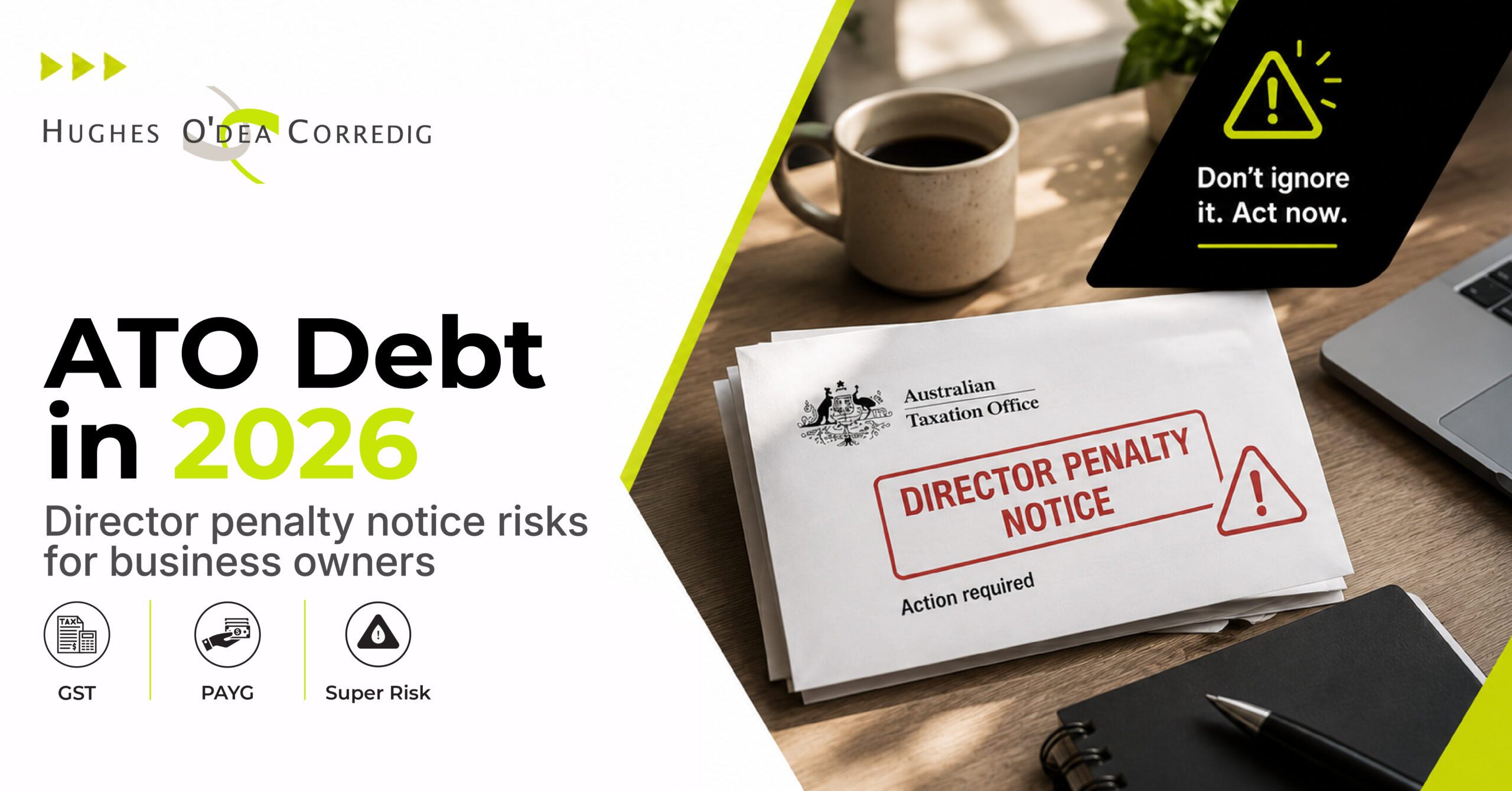
ATO Debt in 2026: Director Penalty Notice Risks for Business Owners
Introduction
Here is a bit of a wake-up call to kick off with.
In the 2024-25 financial year, the ATO issued more than 84,500 Director Penalty Notices. That’s a 136% jump on the year before. And it’s targeting roughly $5.5 billion in unpaid business tax debts.
Now, let that sink in for a second.
If you’re a company director in Australia or even if your business is otherwise healthy, you are now living in one of the most aggressive tax debt enforcement environments this country has ever seen.
The reason it matters? A Director Penalty Notice can make you personally liable for your company’s tax debts. Not the company. You. Your house. Your savings. Your family finances.
And the biggest change in 2026 isn’t just the volume of DPNs. It’s the speed with which they’re arriving.
ATO Deputy Commissioner Anna Longley told the Tax Institute in September that more DPNs and more insolvencies are on the way. And even the Tax Ombudsman has stepped in, announcing a formal review of the ATO’s DPN usage in 2026.
Translation? This isn’t a wave that’s passing. It’s the new normal.
At Hughes O’Dea Corredig (HOC), we’ve been helping directors across Melbourne understand their exposure and get in front of it. So let’s break down what a DPN actually is, when you’re at risk, and what to do if one lands in your mailbox.
The Quick Version
Cut through it and the Director Penalty Notice Australia picture in 2026 is fairly stark.
Here’s the essentials:
- What a DPN does: Makes company directors personally liable for certain unpaid company tax debts. Namely PAYG withholding, GST, and superannuation guarantee charge (SGC).
- How many are being issued: 84,529 in 2024-25, targeting $5.5 billion in liabilities. Expected to keep rising through 2026.
- The two types: Non-lockdown DPN (21 days to act) and lockdown DPN (director is personally liable immediately, no way out through restructure).
- The trigger for a lockdown DPN: Not lodging BAS/IAS or SGC statements within three months of the due date.
- Who’s exposed: Every current director. Former directors too, for liabilities that arose during their tenure.
- The 21-day rule: Non-lockdown DPNs give you 21 days to pay, appoint an administrator, appoint a liquidator, or enter Small Business Restructuring.
Here’s the thing to grasp. In 2026, ATO debt is no longer a company problem you can hide behind. It’s a personal one.
Why Directors Are Genuinely Losing Sleep
Look, the honest truth is that plenty of business owners haven’t fully understood how much has changed. And they’re finding out the hard way.
Here’s what we’ve been hearing week after week from directors across Melbourne.
“I’m a director but I don’t really run the business. So, am I still liable?” Yes. Being a director is being a director. Whether you’re operational or not, your name on the ASIC register puts you on the hook.
“My accountant told me the ATO would just leave us alone if we kept paying something.” That used to be more or less true. It isn’t anymore. Symbolic payments won’t stop a DPN if the ATO thinks the underlying debt is going nowhere.
“We’ve been late lodging BAS for a few quarters – what does that mean?” Potentially a lot. If a BAS is more than three months late, you’re at risk of a lockdown DPN, which means immediate personal liability with no way to escape through voluntary administration.
“My co-director resigned six months ago. Is she off the hook?” Not necessarily. Directors remain liable for debts that arose during their tenure, and for a period after resignation for certain liabilities.
“I’ve had a DPN in the mail for a week. Should I be worried?” If it’s a non-lockdown DPN, you have 21 days from the date of issue to act. Not 21 days from when you opened it. Every day counts.
“Can I put the company into a payment plan and cancel the DPN?” Sometimes. But an ATO payment plan alone doesn’t cancel the DPN clock unless the debt is fully paid within the window. This is where a lot of directors get caught out.
“The debt is mostly super and GST. Is that actually recoverable from me personally?” Yes. PAYG withholding, GST, and superannuation guarantee charge are the three main heads of debt covered by the DPN regime.
Getting proper business tax debt help early is genuinely the difference between manageable and catastrophic in this space.
So What Is a Director Penalty Notice, Really?
Let’s back up and set the scene properly.
A Director Penalty Notice is a formal notice issued by the ATO that can hold company directors personally liable for certain unpaid company tax debts.
The three big ones covered by the regime:
PAYG withholding. The tax withheld from employee wages that should have been sent to the ATO.
GST. Well, obviously. GST included on customer invoices that never got remitted.
Superannuation guarantee charge (SGC). The additional charge applied when a company hasn’t paid super on time. This one bites hard because it’s calculated on all wages (not just ordinary time earnings), plus interest, plus admin fees, and it’s not deductible.
Once the ATO decides to issue a DPN, they have two paths.
Non-lockdown DPN
This is the “less severe” version, but still very serious.
Issued when the company has lodged its returns on time (or late, but before the debt became more than three months overdue), but hasn’t paid the underlying debt. Directors have 21 days from the date of issue to take one of four actions:
- Pay the debt in full
- Appoint a voluntary administrator
- Appoint a liquidator
- Enter Small Business Restructuring (where eligible)
If none of those things happens within 21 days, the director becomes personally liable.
Lockdown DPN
This is the “no way out” version.
Issued when returns weren’t lodged within three months of their due date. When a lockdown DPN is issued, the director is already personally liable. Appointing an administrator or liquidator won’t help and the personal liability is locked in.
The whole regime exists to push directors to engage early. The moment you fall behind on lodgement, the door starts closing.
Why This Matters More Than Directors Realise
The DPN regime has been around for years. What’s changed dramatically in 2026 is the scale of enforcement and the way surrounding rules have tightened.
The DPN numbers are genuinely alarming
84,529 DPNs in 2024-25. Up from 26,702 the year before. That’s not a gradual increase, but that’s a fundamental shift in how the ATO does business.
ATO interest is no longer deductible
We wrote about this recently. From 1 July 2025, GIC and SIC are no longer tax deductible. Combined with GIC currently sitting at 11.17%, some commentators are estimating the effective after-tax cost of carrying an ATO debt is now closer to 18% per annum. Ouch.
Payday Super changes everything from 1 July 2026
The traditional 30-year quarterly super buffer that lets businesses smooth out cash flow? Gone. From 1 July 2026, super must be paid at the same time as wages, thus creating a whole new risk of falling behind and triggering SGC, which then flows into DPN territory.
Personal insolvency risk is real
If you’re hit with a DPN and can’t pay, the ATO can pursue you personally with bankruptcy notices, statutory demands, garnishee action on personal bank accounts. Losing your business is one thing. Losing your house on top is another.
Even former directors can get caught
Resigning doesn’t shield you from liabilities that arose during your tenure. And in certain cases, former directors can be liable for post-resignation debts too if they don’t take proper steps.
For anyone serious about personal liability for company tax debt, this is not a “wait and see” issue.
How the DPN Process Actually Unfolds
Let’s walk through how this plays out in real life.
Stage 1: Debt starts accruing
Your company misses a BAS payment. Or falls behind on super. Or PAYG withholding gets skipped when cash is tight. GIC starts piling up.
Stage 2: The ATO issues reminders
Letters. SMS reminders. Phone calls. Emails to your tax agent. This is the phase where a lot of directors either engage productively or start avoiding the phone. Bad move if you’re in the second camp.
Stage 3: The ATO looks at the file
If reminders don’t get traction, the file gets escalated. The ATO looks at the debt profile, the lodgement history, the payment history, and the director’s engagement level.
Stage 4: DPN gets issued
The DPN gets posted to the address recorded on the ASIC register. It doesn’t matter if you moved five years ago and forgot to update ASIC. It counts as delivered.
Stage 5: The 21-day clock starts (non-lockdown)
Or, for a lockdown DPN, the personal liability is already active on issue. There is no 21-day window.
Stage 6: You act (or you don’t)
Payment. Voluntary administration. Liquidation. Small Business Restructure. Or nothing. In which case, the ATO can begin pursuing you personally.
Stage 7: Personal recovery action
If the 21 days pass without action (or if it’s a lockdown DPN), the ATO can move against you personally. Statutory demand. Bankruptcy notice. Garnishee notice on your personal accounts.
A quick example
Meet “Michael”, the director of a small construction company. The company owes the ATO $180,000, mostly PAYG withholding and unpaid super, all accumulated over 18 months of BAS lodgements filed months late.
Because the BAS wasn’t lodged within three months of the due date, the ATO issues a lockdown DPN.
Michael’s personal liability is immediate. Even if he puts the company into liquidation the next day, the personal debt to the ATO stays with him. His home is at risk. His savings are on the line. His name gets flagged with credit reporting agencies.
Compare that with a scenario where Michael had lodged BAS on time (even if he couldn’t pay). In that case, the ATO would issue a non-lockdown DPN, and Michael would have 21 days to appoint an administrator and potentially avoid personal liability entirely.
Lodgement discipline is everything. Even when the cash isn’t there.
Need your own situation properly assessed? A confidential chat with our business advisory team is usually the fastest way to know where you actually stand.
Your DPN Risk Checklist
Bookmark this. Here’s the checklist we’re using with directors right now.
1. Confirm your ASIC address is current
Sounds basic. The ATO posts DPNs to your ASIC-registered address. Miss it and the clock still runs. Update ASIC today if you haven’t recently.
2. Get your BAS lodgements up to date immediately
Even if you can’t pay, lodging keeps you in “non-lockdown” territory. Every unlodged BAS more than three months old is a potential lockdown DPN waiting to happen.
3. Lodge your SGC statements on time
Superannuation guarantee is one of the three DPN heads. Miss the SGC lodgement window and you’re inviting personal liability.
4. Check your prior 12 months of tax obligations
If you’re behind on anything like PAYG, GST, super, get it on the register properly. Don’t wait for the ATO to find it.
5. Model your real ATO exposure
What’s the total company tax debt? Which parts sit inside DPN territory? What’s your personal exposure if the ATO acts today?
6. Consider a properly structured payment plan
An ATO payment plan can genuinely help, but only if it’s realistic, sustainable, and properly negotiated. The ATO’s own online payment plan tool is not a strategy.
7. Talk to a professional before you respond to any DPN
If a DPN lands, do not ignore it. Do not delay. And don’t reply directly to the ATO without advice. What you say or don’t say in the first 48 hours can shape everything that follows.
8. Review Small Business Restructuring eligibility
The Small Business Restructuring regime allows eligible companies to restructure debts with creditor consent while directors remain in control. In the right situation, it can be the difference between survival and liquidation.
9. If you’re a former director, check your risk
Debts that arose during your tenure can still catch you. Make sure any current or historical exposure is properly reviewed.
10. Have your accounting records genuinely up to date
You can’t defend yourself against a DPN if you can’t produce clean, current financial records. That preparation happens now, not when the notice arrives.
Getting an ATO director penalty notice review sooner rather than later is honestly one of the cheapest bits of protection you’ll ever buy.
Common Mistakes and Myths Doing the Rounds
There’s a huge amount of bad information about DPNs floating around. Let’s knock the biggest ones on the head.
Myth 1: “The company owes it, not me.”
Not once a DPN is on the table. That’s the whole point of the regime. It pierces the corporate veil for certain tax debts. Your company structure won’t protect you.
Myth 2: “I can resign and the debt goes away.”
Wrong. Directors remain personally liable for debts that arose during their tenure. Resignation doesn’t wipe the slate.
Myth 3: “If the ATO is happy with a payment plan, the DPN goes away.”
Not automatically. A payment plan can prevent further action if the debt is being cleared properly, but the DPN itself only “resolves” if the underlying debt is dealt with in an acceptable way. Miss a plan payment and you can find yourself right back in DPN territory fast.
Myth 4: “Lockdown DPNs are rare.”
Not anymore. As the ATO’s enforcement mood has hardened, lockdown DPNs are being issued more often, especially where directors have a track record of late lodgement.
Myth 5: “I can just put the company into liquidation to get out of it.”
For a non-lockdown DPN, yes. Appointing a liquidator within 21 days can lift the personal liability. But for a lockdown DPN, liquidation doesn’t help. The personal liability is already locked in.
Myth 6: “The ATO won’t come after my house.”
Yes they will. Statutory demands, bankruptcy notices, garnishee action, all standard ATO recovery tools once personal liability is established.
Myth 7: “Small businesses fly under the radar.”
Absolute fiction. Small businesses owe roughly two-thirds of Australia’s collectible tax debt. The ATO’s focus is squarely on smaller operators.
When to Take Action
If you are asking honestly, then it was yesterday. But the next best time is right now.
Act now if:
- You’re currently a director of any Australian company
- You’re behind on BAS lodgements (particularly by more than three months)
- Your company has unpaid PAYG withholding, GST, or superannuation
- You’ve had reminders or contact from the ATO in recent months
- You’ve resigned from a directorship in the last 12 months
- You’re carrying director loans or unpaid entitlements
Treat it as urgent if:
- You’ve received a DPN in the mail
- You’ve received an ATO letter warning of “firmer action”
- Your ATO debt exceeds $100,000
- Your ASIC-registered address is not current
- You’ve been told a DPN is being considered
- You’ve had a garnishee notice issued
The single biggest predictor of a bad DPN outcome? Delay. The directors who engage early, lodge on time even when they can’t pay, and get advice fast. They generally survive. The ones who hope for the best, ignore reminders, and let BAS pile up? They cop the full hit.
Get proper ATO debt help for directors before the notice arrives, not after.
How HOC Helps Directors Manage ATO Debt Risk
This is where Hughes O’Dea Corredig fits in. We’re a Melbourne-based firm in Essendon, and helping business owners across Victoria and increasingly nationally navigate ATO debt has become one of the busiest parts of our practice in 2026.
We’re not the kind of firm that just files your BAS and moves on. We’re the kind that actually looks at your exposure, asks the hard questions, and helps you get in front of things before they blow up.
Business Advisory and Turnaround
Our business advisory team works with directors on real-world debt management strategies. That includes ATO debt reviews, payment plan negotiations, cash flow forecasting, Small Business Restructure eligibility assessment, and honest conversations about viability. No sugar-coating.
Tax Planning and Compliance
Our tax planning team helps ensure your BAS, PAYG, GST, and SGC obligations are lodged on time, every time, because that lodgement discipline is what separates a manageable ATO conversation from a catastrophic one.
Succession and Restructuring Planning
For directors thinking about resignation, retirement, or handing the business over, our succession planning services look at how to do it in a way that doesn’t leave you personally exposed to debts that arose during your tenure.
Whether you’re just around the corner in Essendon or dialling in from anywhere in Australia, our team delivers proper, practical ATO director penalty notice review and business tax debt support without the runaround.
FAQs – DPN Risks Answered
What is a Director Penalty Notice?
It’s a formal notice issued by the ATO that can make company directors personally liable for unpaid PAYG withholding, GST, and superannuation guarantee charge debts of the company. Once issued, directors typically have 21 days to act before personal recovery action can begin.
Can directors be personally liable for company tax debt?
Yes. For PAYG withholding, GST, and SGC, directors can be personally liable through the DPN regime. Other company tax debts (like company income tax) don’t fall under the same regime, but can be pursued through other means.
What happens if a company does not pay GST?
Unpaid GST can trigger a DPN, making directors personally liable. It also attracts GIC (currently 11.17% and no longer tax deductible), and can lead to garnishee notices, wind-up applications, and personal recovery action.
Can directors be liable for unpaid super?
Yes, and this is one of the biggest areas of risk. Unpaid superannuation triggers the superannuation guarantee charge (SGC), which is one of the three heads covered by the DPN regime. Once SGC is unpaid, personal liability can follow quickly.
What to do if you receive a Director Penalty Notice?
Do not delay. Do not respond to the ATO without advice. Get to a specialist within 24 hours if possible. You have 21 days to act (for non-lockdown DPNs), and every day matters.
Can an ATO payment plan stop a Director Penalty Notice?
An ATO payment plan can help avoid a DPN being issued in the first place, and can support a defence to certain claims once one is issued. But it doesn’t automatically cancel a DPN — the underlying debt still needs to be resolved.
What’s the difference between a lockdown and non-lockdown DPN?
Non-lockdown DPN: Issued when returns were lodged on time (even if the debt wasn’t paid). Gives directors 21 days to pay, appoint an administrator, appoint a liquidator, or enter Small Business Restructure.
Lockdown DPN: Issued when returns weren’t lodged within three months of their due date. Personal liability is immediate. So restructuring won’t help.
How long do I have to act on a DPN?
For a non-lockdown DPN, 21 days from the date of the notice (not the date you receive it). For a lockdown DPN, you’re already personally liable when it’s issued, but you still need to act fast to manage the fallout.
Why Our Advice Holds Up
Look, DPN work is one of those areas where good advice can save you your house, and bad advice can cost you everything. We take it seriously.
Here’s why directors across Melbourne keep coming back to Hughes O’Dea Corredig:
- Decades of experience helping business owners through tax debt, ATO disputes, restructuring, and voluntary administration
- Registered Tax Agents with current technical knowledge of the DPN regime and 2026 enforcement environment
- Integrated team of tax, business advisory, SMSF, succession, financial planning, and estate planning all in one firm
- A confidential, no-judgement approach. We’ve genuinely seen it all, and we lead with practical options
- Active tracking of ATO guidance, Tax Ombudsman reviews, and updates from professional bodies like CPA Australia and CA ANZ
Reviewed by the HOC tax and business advisory team, April 2026. This article is general information only and doesn’t replace tailored advice for your specific situation.
Your Next Step – Book a Confidential DPN Review
If you’re a company director carrying any ATO debt or you’re worried about your exposure, the single most useful thing you can do right now is have a confidential conversation with someone who understands the DPN regime properly.
Book a confidential DPN review
Our team offers a fully confidential DPN and business tax debt review session where we look at your current exposure, map out your personal risk, review lodgement history, and put together a practical action plan.
Call HOC on +61 3 9375 4286 or email mail@hoc.com.au to lock in a time.
Or take a look around first
Not ready to book yet? Have a browse through our business advisory services, tax planning practice, and succession planning support to see how we work.
Related Resources
- Key things for investors to keep in mind during times of market turmoil
- Investing Strategies for Financial Freedom: Leveraging Melbourne’s Elite Financial Planning Services
- [SMSF Assets series] ATO recommends licensed financial advisory to SMSF trustees investing in Crypto Assets
- Mastering Cash Flow Management: 9 Proven Moves for Melbourne Small Business
- Where does all my money go? Save money on your three biggest expenses
- ATO recommends licensed financial advisory to SMSF
- ATO Tax Changes 2026: What Small Business Owners Need to Know
- Master Your Money: Open Banking Australia & Real-Time Cash Flow
- AI-Driven Accounting in 2026: How Businesses Are Redefining Financial Services
- Tax Time Preparation : Everything You Need to Know Before EOFY 2026
- How to grow your superannuation in 2026: Essential Strategies for Australian Workers!!!
- 2026–27 Federal Budget: What It Means for Australian Small Business Owners
ATO — New TPAR Pre-Fill for Tax Time 2026
ATO — Pre-Filling 2026 Guidance
Wrapping Up
Let’s bring it in to land.
The Director Penalty Notice landscape in 2026 is genuinely different to anything Australian business owners have faced before. 84,000+ DPNs in a single year. Non-deductible ATO interest. Payday Super removing the traditional cash flow buffer. Tax Ombudsman scrutiny of the whole regime.
For directors, this is a moment. If your BAS is behind, if your super is unpaid, if your PAYG is short, this is the year to sort it out. Not next quarter. Not “when things pick up”.
The directors who come out of 2026 in one piece? They’re the ones who engaged early, kept lodgements current, got advice before the letter arrived, and structured payment plans that actually work. The ones who didn’t? They’re losing houses, retirement savings, and marriages.
Don’t be in that second group.
Book your confidential DPN and business tax debt review with Hughes O’Dea Corredig and get proper protection before the letter shows up. Not after.
Hughes O’Dea Corredig is a Melbourne accounting firm specialising in tax planning, business advisory, SMSF, financial planning, succession, and estate planning. Based in Essendon, we look after business owners, directors, and families across greater Melbourne and nationally via secure remote service. Information in this article is general and current as of April 2026. Please get personalised advice before making any decisions about your ATO debt or DPN response.
zAbout Hughes O’Dea Corredig
Hughes O’Dea Corredig is a Melbourne-based accounting and wealth management firm with over three decades of experience helping individuals and businesses achieve financial freedom.
Our Core Services:
Wealth Management • Tax Advisory • Superannuation • SMSF Management • Business Accounting • Business Adviosry , Retirement Planning etc.
🌐 www.hoc.com.au | 📍 Level 2, 333 Keilor Road, Essendon VIC 3040 | 📧 mail@hoc.com.au
Connect with Us
Follow our latest insights and expert opinions:
🔗 LinkedIn 📘 Facebook

Categorised in: Uncategorized